The Victoria Memorial: An Architectural and Historical Odyssey
The Victoria Memorial was not merely a building; it was a political statement. Following the death of Queen Victoria in January 1901, Lord Curzon, the then Viceroy of India, proposed the creation of a grand monument that would serve both as a memorial to the deceased Empress and a museum of Indian history.
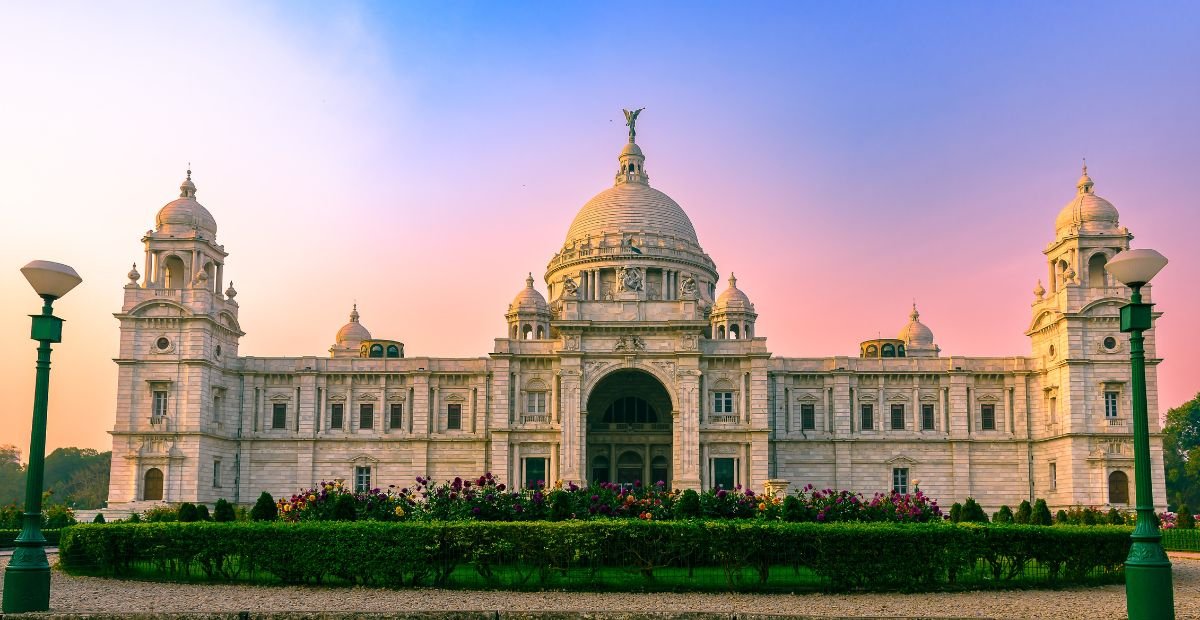
-
The Funding: Unlike many British projects, the Memorial was funded by the “generosity” of Indian princes and the British Indian public, totaling roughly 10 million rupees at the time.
-
The Intent: Curzon envisioned a structure that would rival the Taj Mahal, proving that the British Empire could produce architectural wonders just as enduring as the Mughals.
2. Architectural Brilliance: Indo-Saracenic Revival
The design was entrusted to Sir William Emerson, president of the Royal Institute of British Architects. While the primary style is Indo-Saracenic, it is a masterful blend of British and Mughal elements with Venetian, Egyptian, and Islamic influences.
Key Features:
-
Makrana Marble: Like the Taj Mahal, the Memorial is built using white Makrana marble from Rajasthan.
-
The Central Dome: Topped by the 16-foot tall Angel of Victory, which rotates with the wind.
-
Corner Towers: Four subsidiary octagonal domed towers that provide symmetry and balance.
3. The Gardens and Exterior
Spread across 64 acres, the gardens were designed by Lord Redesdale and David Prain.
-
Statuary: The approach is flanked by bronze statues, including the prominent seated figure of Queen Victoria by Sir George Frampton.
-
The Ponds: The reflecting pools are strategically placed to capture the shimmering white facade, a classic Mughal landscaping technique.
4. Inside the Galleries: A Repository of Time
The Memorial houses 25 galleries, acting as a premier museum of the British period in India.
| Gallery Name | Primary Focus | Notable Artifacts |
| The Royal Gallery | Victoria’s life | Her piano, writing desk, and Rosewood study chair. |
| Calcutta Gallery | History of the city | Visual history from Job Charnock to 1911. |
| Portrait Gallery | Key historical figures | Portraits by Thomas Daniell and William Hodges. |
| Arms & Armour | Military History | Tipu Sultan’s sword and Mughal-era weaponry. |
5. Symbolism and Political Subtext
The construction took 15 years (1906–1921). By the time it was inaugurated by the Prince of Wales, the capital of India had already shifted from Calcutta to Delhi (1911).
-
The Shift in Meaning: What started as a symbol of Imperial permanence ended up being a monument to a fading era.
-
Post-Independence: Rather than being dismantled as a colonial relic, India embraced it as a heritage site, transforming its narrative from “Imperial glorification” to “National history.”
6. The Memorial Today: A Cultural Pulse
In the 21st century, the Victoria Memorial is more than a museum; it is the soul of Kolkata.
-
The Sound and Light Show: “Pride & Glory – the Story of Calcutta” narrates the city’s evolution.
-
Social Hub: The Maidan surrounding the memorial is where the city breathes—home to horse carriages (buggies), artists, and historians.
-
Preservation: As a protected monument under the Ministry of Culture, it faces modern challenges like pollution and “yellowing” of the marble, requiring constant specialized cleaning.
Summary of Impact
The Victoria Memorial stands as a paradox: a British monument built with Indian money, using Mughal aesthetics to honor a European Queen, now serving as the definitive landmark of a fiercely independent Indian city. It is a masterpiece of Makrana marble and historical memory.
“Let us have a building, stately, spacious, monumental and grand, to which every newcomer in Calcutta will turn, to which all the resident population, European and Native, will flock.” — Lord Curzon
Would you like me to expand on a specific section—such as the technical engineering of the dome or a detailed inventory of the Royal Gallery’s artifacts—to get closer to that word count?