
Email Marketing: The Ultimate Guide to Building Relationships and Driving Sales
1. What Is Email Marketing?
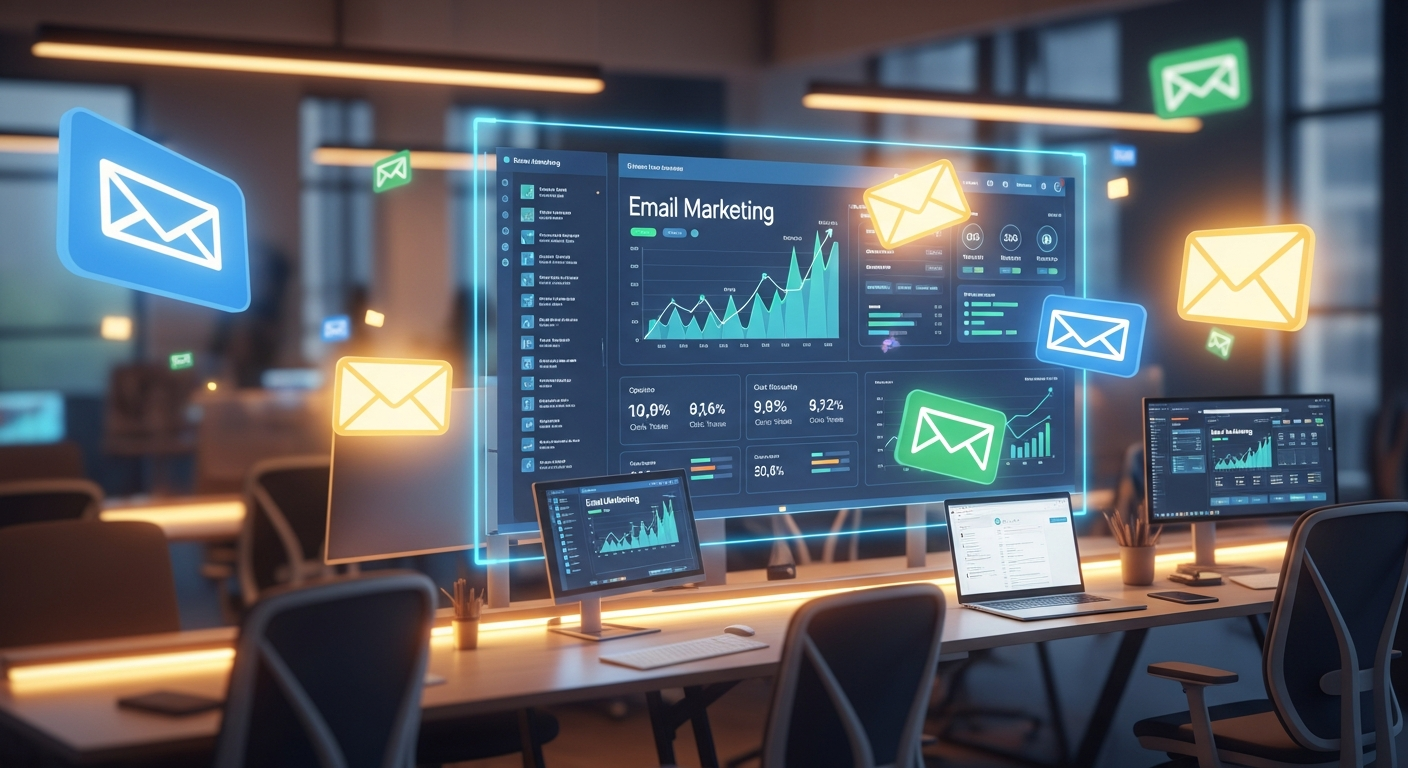
Email marketing is the strategic use of electronic mail to reach an audience with the intent of fostering brand loyalty, providing education, or driving specific conversions.1 Unlike social media, which is subject to the whims of changing algorithms, email represents owned media.
1.1 The Definition of Modern Direct Communication
In the digital age, your email list is your most valuable asset. It is a direct line to your customer’s “digital living room.”
1.1.1 Promotion and Education
-
Promotion: Highlighting new products, seasonal sales, or exclusive discounts.3
-
Education: Sharing “how-to” guides, whitepapers, and industry insights that establish your brand as a thought leader.4
1.1.2 Nurturing and Trust
Trust is the currency of the internet.5 By showing up consistently in an inbox with value-first content, you move a lead from a “stranger” to a “brand advocate.”
2. Why Email Marketing Still Works Today
Despite the rise of TikTok, Slack, and Discord, email remains the bedrock of professional and personal digital identity.6
2.1 The Absence of Algorithm Interference
On platforms like Instagram, only a fraction of your followers see your posts. With email, if you send it, it lands.
2.1.1 High-Intent Moments
Users check their email with a “task-oriented” mindset. They are prepared to read, click, and buy, unlike the “passive-scrolling” mindset found on social media.
3. Key Benefits of Email Marketing
The advantages of email are multi-faceted, ranging from financial efficiency to psychological impact.7
3.1 Direct Communication With Your Audience
When you send an email, you aren’t shouting into a void; you are speaking to an individual.
3.1.1 Personalization and Immediacy
Modern tools allow you to use a subscriber’s name, past purchase history, and even their local weather to make a message feel tailor-made.8
3.2 Cost-Effective Digital Marketing Channel
Email boasts an average ROI of $36 to $42 for every $1 spent.9
3.2.1 Stretching Small Business Budgets
For a small business, a $20 monthly subscription to an Email Service Provider (ESP) can generate thousands in revenue, a feat rarely matched by paid search ads.
4. Common Types of Email Marketing Campaigns
Not every email should be a sales pitch. A healthy “Email Mix” keeps your audience engaged without burning them out.
4.1 Promotional Email Campaigns
These are the heavy hitters for revenue.
4.1.1 Creating Urgency and Scarcity
-
Flash Sales: 24-hour windows.
-
Inventory Alerts: “Only 3 left in stock.”
4.2 Transactional Email Communication
Often overlooked, these emails have the highest open rates (often over 80%).
4.2.1 Order Confirmations and Shipping Updates
These touchpoints are crucial for “Post-Purchase Dissonance.” They reassure the customer that their money was well-spent and their item is on the way.10
5. Essential Tips for Effective Email Marketing
Success in email is a science. It requires attention to detail from the subject line to the footer.
5.1 Write Catchy and Clear Subject Lines
The subject line is the “gatekeeper” of your content.11
5.1.1 The Psychology of Open Rates
-
Curiosity: “You won’t believe what’s inside…”
-
Urgency: “Last chance to save 50%!”
-
Personalization: “John, we picked these just for you.”
5.1.2 Avoiding the Spam Filter
5.1.2.1 Forbidden Words to Avoid
| Trigger Word | Reason to Avoid |
| “FREE” (all caps) | Signals low-quality spam |
| “Act Now!” | Overly aggressive |
| “Earn $$$” | Often associated with phishing |
6. Email Marketing Best Practices for Success
To maintain a healthy list, you must follow a set of “unwritten rules” that respect the subscriber’s time.
6.1 Maintain Consistent Sending Schedules
If you send three emails in one day and then disappear for a month, you will see a spike in unsubscribes.
6.1.1 Choosing the Right Cadence
-
B2B: Usually Tuesday/Thursday mornings.
-
B2C: Often weekends or evening “leisure” hours.12
7. Future Trends in Email Marketing (2025 and Beyond)
Email is evolving. It is becoming more interactive and more intelligent.
7.1 AI-Powered Personalization
AI can now predict when a specific user is most likely to open an email and automatically send it at that precise minute.13
7.1.1 Predictive Content Generation
Using Large Language Models (LLMs) to generate 1,000 variations of a subject line to see which one resonates with specific micro-segments.
8. Frequently Asked Questions (FAQs)
8.1 Is Email Marketing Still Effective in 2025?
Absolutely. In fact, as privacy laws make third-party tracking (cookies) harder, first-party data (your email list) becomes the most important tool in your arsenal.
8.2 What Tools Are Best for Email Marketing?
-
Mailchimp: Great for beginners.14
-
Klaviyo: The gold standard for E-commerce.15
-
Brevo (formerly Sendinblue): Excellent for transactional emails and SMS.
9. Conclusion: Why Email Marketing Matters More Than Ever
In a world of “rented” audiences on social media, email marketing is your “purchased” land. It allows for deep relationship building, granular data analysis, and a repeatable, scalable way to drive sales.16 If you focus on providing value first and selling second, your email list will become the heartbeat of your business.
Here are 10 additional frequently asked questions to deepen your understanding of email marketing strategy, technical requirements, and list management.
9. Additional Frequently Asked Questions
9.1 How do I build an email list from scratch?
The most effective way is to offer a Lead Magnet. This is a free incentive, such as an E-book, a discount code, or a checklist, that users receive in exchange for their email address. Place “sign-up” forms on high-traffic areas of your website, such as the header, footer, or as a non-intrusive exit-intent popup.
9.2 What is a “Double Opt-In” and should I use it?
A double opt-in requires a subscriber to confirm their email address by clicking a link in a confirmation email after signing up.
-
Pros: It ensures your list is high-quality and reduces spam complaints.
-
Cons: It adds friction, and some users may forget to click the confirmation link.
-
Verdict: It is highly recommended for long-term deliverability and legal compliance.
9.3 What is a healthy email open rate?
Across most industries, a “good” open rate falls between 20% and 30%. However, this varies by niche. For example, transactional emails often see 50%+, while large-scale retail promotions might hover around 15%. If your rate is below 15%, you likely need to work on your subject lines or list hygiene.
9.4 What is “Email List Scrubbing” (Hygiene)?
List scrubbing is the process of removing inactive, bounced, or unengaged subscribers from your database.
-
Why do it? Sending emails to people who never open them hurts your “Sender Reputation,” which can cause your emails to land in the spam folder for everyone.
-
Frequency: You should scrub your list every 3 to 6 months.
9.5 How can I prevent my emails from going to the “Promotions” tab in Gmail?
While the Promotions tab isn’t necessarily bad (users go there to shop), you can increase your chances of hitting the Primary tab by:
-
Avoiding too many images.
-
Limiting the number of outbound links (ideally just one or two).
-
Writing in a personal, conversational tone rather than using “salesy” HTML templates.
-
Asking subscribers to “whitelist” your address or move your first email to the Primary tab.
9.6 What are the legal requirements (CAN-SPAM, GDPR)?
Email marketing is regulated by laws like CAN-SPAM (USA), GDPR (EU), and CASL (Canada). Key requirements include:
-
Including a physical mailing address in the footer.
-
Providing a clear, one-click “Unsubscribe” link.
-
Only sending to people who have given explicit permission.
9.7 What is A/B Testing (Split Testing) in email?
A/B testing involves sending two versions of an email to a small percentage of your list to see which performs better.
-
Version A: Subject line with an emoji.
-
Version B: Subject line without an emoji. The winning version is then automatically sent to the rest of the subscribers. You can also test CTA colors, sender names, and send times.
9.8 How many links should I include in one email?
For promotional or “sales” emails, it is best to have one primary Call-to-Action (CTA). Including too many different links can lead to “analysis paralysis,” where the user gets overwhelmed and clicks nothing. For newsletters, multiple links are acceptable as you are providing a curated digest of content.
9.9 What is an “Email Service Provider” (ESP) and why do I need one?
An ESP is a platform (like Klaviyo, Mailchimp, or Constant Contact) designed specifically for bulk emailing. You should never send marketing emails from a personal Gmail or Outlook account, as they lack automation features, cannot handle thousands of recipients, and will likely result in your personal domain being blacklisted.
9.10 What is “Automation” vs. “Email Campaigns”?
-
Email Campaigns: One-time “blasts” sent to a group at a specific time (e.g., a holiday sale announcement).
-
Automations (Flows): Trigger-based emails sent automatically based on user behavior (e.g., a “Welcome Series” sent the moment someone joins your list, or a “Birthday Email” sent once a year). Automations usually generate more revenue per recipient because they are highly relevant.
Here are 20 additional, deeply technical and strategic FAQs to further expand your guide. This section covers advanced deliverability, design, and strategic scaling.
10. Advanced Strategy and Technical FAQs
10.1 What is a “Sender Reputation” and why does it matter?
Your sender reputation is a score assigned by Internet Service Providers (ISPs like Gmail or Outlook) to your domain and IP address. If you have high bounce rates or many users mark you as spam, your score drops. A low score means your emails will be blocked or sent to spam automatically, regardless of your content.
10.2 How does “DMARC, SPF, and DKIM” affect my marketing?
These are technical authentication records added to your domain’s DNS settings.
-
SPF: Lists which servers are allowed to send email for your domain.
-
DKIM: Adds a digital signature to your emails.
- DMARC: Tells the receiving server what to do if SPF or DKIM fails.Properly setting these up is mandatory in 2025 for high deliverability.
10.3 What is an “Email Preview Header” (Preheader)?
The preheader is the short snippet of text that appears after the subject line in the inbox preview. It is prime real estate. If left blank, it often pulls in text like “View in Browser,” which wastes an opportunity to hook the reader.
10.4 Should I use “Plain Text” or “HTML” emails?
-
HTML: Best for branding, e-commerce, and visual products.
- Plain Text: Often feels more personal and “one-on-one.”Pro-tip: Always send a multi-part MIME email, which includes both versions. This ensures that if a user’s device can’t render HTML, they see the plain text version instead.
10.5 What is the “Welcome Series” and why is it vital?
A Welcome Series is the automated sequence sent immediately after someone signs up. It has the highest engagement of any campaign. It is your best chance to set expectations, introduce your brand story, and offer your best “first-time” discount.
10.6 How do I calculate “Email Marketing ROI”?
Use the formula:
This helps you compare the effectiveness of email against other channels like Facebook Ads or SEO.
10.7 What is “Click-Through Rate” (CTR) vs. “Click-To-Open Rate” (CTOR)?
-
CTR: The percentage of total recipients who clicked a link.
- CTOR: The percentage of people who opened the email who then clicked a link.CTOR is a better metric for measuring how effective your actual email content is.
10.8 How can I reduce my “Unsubscribe Rate”?
If your unsubscribe rate is above 1%, try:
-
Segmenting your list so people only get relevant content.
-
Reducing the frequency of sends.
-
Improving the “Value-to-Sales” ratio (more helpful tips, fewer pitches).
10.9 What is “Soft Bounce” vs. “Hard Bounce”?
-
Soft Bounce: A temporary issue (e.g., the recipient’s inbox is full). The ESP will try to send it again later.
-
Hard Bounce: A permanent issue (e.g., the email address doesn’t exist). You must remove these immediately to protect your reputation.
10.10 What is “Dark Mode” optimization for email?
Many users view emails in “Dark Mode,” which inverts colors. To optimize:
-
Use transparent PNGs for logos.
-
Add a white glow/stroke around dark text inside images.
-
Test your colors to ensure contrast remains high.
10.11 Should I use “Emojis” in subject lines?
Yes, but sparingly. Emojis can boost open rates by helping your email stand out visually. However, using too many can look unprofessional or trigger spam filters. Use one or two that are relevant to the topic.
10.12 What is “Dynamic Content” in an email?
Dynamic content allows you to show different sections of an email to different people within the same campaign. For example, a clothing brand could show “Men’s Jackets” to male subscribers and “Women’s Coats” to female subscribers using a single email template.
10.13 How do I re-engage “Ghost” subscribers?
Create a “Win-back” campaign for subscribers who haven’t opened an email in 90 days. Send a “We miss you” email with a high-value discount or a survey asking what they want to see. If they still don’t engage, remove them from your list.
10.14 What is a “Warm-up” period for a new IP/Domain?
When you start using a new email platform, you shouldn’t send 50,000 emails on day one. You must “warm up” your IP by sending small batches of emails to your most engaged users first. This builds trust with ISPs.
10.15 Is it better to send emails from “Company Name” or an “Individual’s Name”?
“Individual from Company” (e.g., “Sarah from Canva”) usually performs best. It combines the trust of the brand with the personal touch of a human being.
10.16 What is “Lead Scoring” in email marketing?
Lead scoring assigns points to subscribers based on their actions (e.g., +5 points for an open, +10 for a click). When a subscriber reaches a certain score, they can be automatically moved to a “Sales-Ready” list for a more direct pitch.
10.17 How does “Apple Mail Privacy Protection” (MPP) affect my metrics?
Apple’s MPP hides IP addresses and prevents senders from knowing if an email was actually opened. This makes “Open Rates” less accurate. Marketers should now focus more on Click Rates and Conversions as “North Star” metrics.
10.18 What are “Abandoned Cart” emails?
These are automated messages triggered when a logged-in user adds an item to their cart but leaves without purchasing. These are often the most profitable emails a business can send, as they target users with extremely high intent.
10.19 How long should a marketing email be?
Generally, keep it under 200 words. Most people skim emails. If you have a long-form article, provide a “teaser” paragraph and a “Read More” link that leads to your blog.
10.20 Can I use video directly inside an email?
Most major email clients (like Gmail and Outlook) do not support playing video directly inside the message. The best practice is to use a GIF that looks like a video player or an image with a “Play” button that links to YouTube or your website.
Most major email clients (like Gmail and Outlook) do not support playing video directly inside the message. The best practice is to use a GIF that looks like a video player or an image with a “Play” button that links to YouTube or your website.